The 2026 Student Housing Tax Guide: Save with 'Cedolare Secca'
The flat-rate tax ('cedolare secca') is a real game-changer for landlords, letting you pay a fixed substitute tax instead of the usual, heavy IRPEF tax on rental income. If you're renting to university students, it can save you serious money. Here is everything you need to know in our quick guide.
The main points:
The "cedolare secca" (flat-rate tax) replaces standard income tax, registration tax, and stamp duty with a single flat rate: 21% for free-market rentals, and 10% for agreed-rate rentals in high-density areas (which includes most university cities). The savings are real—hundreds of euros a year per room. You must opt in using the RLI form when registering the contract. Choosing this means giving up annual inflation (ISTAT) rent increases, and to qualify for the 10% rate, your rent must fall within local agreed limits.

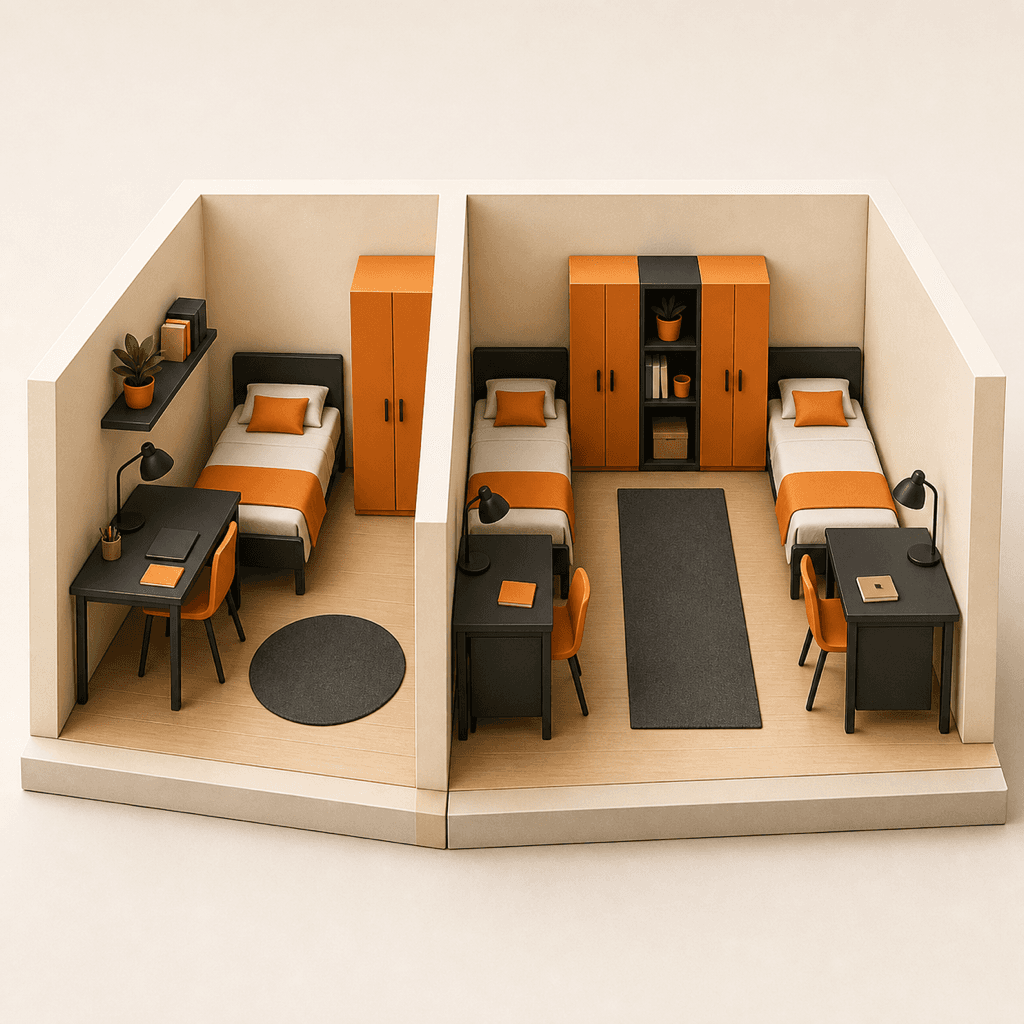
Illustration generated with AI
For illustrative purposes only; not a specific property.
Flat-rate tax for student rentals: everything you need to know
If you are renting a room or an apartment to university students and haven't looked into "cedolare secca" (flat-rate tax) yet, you are probably paying more tax than you need to. The flat-rate tax is one of the most profitable tax tools for small landlords—but it only works if you set it up right. Here is your complete guide.
What is cedolare secca?
The cedolare secca is an optional tax scheme that replaces the standard IRPEF (personal income tax) on rental income. Instead of adding your rent earnings to your overall income and paying your top personal tax bracket rate, you pay a single flat-rate tax—regardless of what else you earn.
This makes it incredibly advantageous for mid-to-high earners, whose personal income tax bracket is way higher than the flat-rate tax rates.
The flat-rate tax rates
There are two main rates.
21% — applies to standard, open-market contracts (canone libero), regardless of who the tenant is. This is the standard flat-rate tax and makes sense compared to IRPEF if your income tax bracket is over 23%.
10% — applies to agreed-rate contracts (canone concordato) in metropolitan areas and high-demand student cities. This is the ultimate money-saver and the most relevant one if you are renting to university students on a transitional student contract in high-demand areas.
The difference between 21% and 10% is huge over a year. On a rent of €500 a month, you are looking at saving about €660 every single year.
When does the 10% rate apply?
The reduced 10% rate applies when three conditions are met at the same time: the contract must be an agreed-rate lease (canone concordato) based on local agreements between landlord and tenant associations; the property must be in a designated high-demand municipality (almost every major Italian university city fits the bill); and the lease must be properly registered with the Agenzia delle Entrate.
For transitional student contracts in cities with active local agreements, the 10% rate is generally good to go. Just make sure to double-check the specific rules for your municipality.
How to apply for the flat-rate tax
You choose the flat-rate tax when registering the lease with the Agenzia delle Entrate. It is not automatic—you have to actively opt-in by filling out the RLI form (Request for Registration and subsequent fulfillments for lease and rental contracts).
You can also switch to it for active contracts at the first available annual renewal deadline.
Once you opt for the flat-rate tax, you cannot increase the rent for the entire duration of the contract—meaning you give up annual inflation adjustments (ISTAT). For short-term student contracts, this is rarely an issue anyway.
What does the flat-rate tax replace?
With the flat-rate tax, you don't pay IRPEF on your rental income, regional and municipal IRPEF surcharges, the annual registration tax on the lease, or the stamp duty. It completely replaces all these costs with a single flat rate.
Flat-rate tax vs standard IRPEF: which wins?
The flat-rate tax is almost always the winner when renting to university students, but let us look at the actual numbers.
Let's base this on €500 a month in rent, which is €6,000 a year. With the 21% flat-rate tax, you pay €1,260 in tax. With the 10% flat-rate tax, you pay €600. With standard IRPEF at 27% (for earnings between €28,000 and €50,000), you pay around €1,620—plus regional and municipal surcharges.
The savings are crystal clear. And with the 10% rate, the deal gets even sweeter.
Key boxes you must tick
Even with the flat-rate tax, there are still a few mandatory rules. Registering the lease with the Agenzia delle Entrate within 30 days of signing is still a must—the flat-rate tax does not exempt you from registration, it just changes how you are taxed. Declaring your rental income on your annual tax return is still mandatory. And declaring foreign tenants to the local police (questura) is always required within 48 hours of move-in.
The most common mistakes
Not checking your municipality. Not all towns qualify as high-demand areas. Before applying the 10% rate, make sure your town is on the official up-to-date list.
Ignoring the agreed-rate rent limits. To qualify for the 10% rate, your rent must sit within the local agreement cap. If you charge more than the maximum allowed, you cannot use this rate.
Failing to register the lease. An unregistered lease means you can't use the flat-rate tax at all, and it exposes you to serious fines.
Increasing the rent. Remember, when you opt for the flat-rate tax, you waive any ISTAT inflation adjustments for as long as you are on the system.
Our final tip
The flat-rate tax is a game-changer, but you need to check if it fits your specific situation. The variables—the lease type, the town, your tax bracket, and the rent amount—can dramatically change which option is best for you.
Before you choose, check with an accountant or a CAF tax help centre for a personal assessment. Investing in professional advice will pay for itself in the tax savings you will secure.
At Stanza Semplice, we guide our partner landlords through every tax aspect of student housing. Get in touch today to see how we can handle everything and help you get the best return on your property.
Our tip
“
If you're renting to students and haven't switched to the 10% flat-rate tax (cedolare secca), you're likely throwing money away: on a €500 room, you're looking at a difference of about €660 a year between the 21% and 10% tax rates. The two requirements are an agreed-market rent within local limits and a high-housing-demand municipality — double-check these, then tick the box on your RLI form. Wave goodbye to the ISTAT inflation adjustment? With short-term contracts, it's rarely an issue.